
Three Greer Release Dates
Oklahoma records use several dates that sound alike. A projected release date, or PRD, is ODOC’s current estimate for the end of confinement after sentence rules and earned credits are applied. A parole eligibility or docket date marks when a case may be reviewed. It does not promise approval. A discharge date is a historical end date recorded for a sentence or supervision event. The same person may reach eligibility, be denied or passed, later leave prison on parole, and remain supervised until discharge.
County custody works differently. A Greer County Jail detainee awaiting trial may leave on bond or another court order, but no sentence calculation fixes that date in advance. A person serving a county term may have jail credit or a court-defined term. Research found no published Greer County good-time formula or automatic weekend rule. Ask the jail and court for the actual credit and closing event.
| Date | What it means | What it does not prove |
|---|---|---|
| Projected release date | ODOC estimate based on current sentence computation | The exact future gate date |
| Parole eligibility or docket | Possible consideration by the Board | Approval or physical release |
| Discharge date | Historical end shown on the matching sentence row | That every other sentence or hold ended then |
| Jail release entry | Greer Jail’s closing event for one booking | Community freedom if the event was a transfer |
Find a Greer Release Date
Classify the last known custody before searching. The ODOC Offender Lookup covers state prison sentences and ODOC supervision, including people held at Oklahoma State Reformatory. It does not cover every short county-jail booking. Use a DOC number when known and open the detail rather than stopping at the results list.
- Confirm the facility. Use ODOC for a state prisoner and the sheriff plus court for a Greer County Jail detainee.
- Match the identity. Compare name, DOC number, date of birth, photo, aliases, sentencing court, and CRF or case number.
- Read all sentence rows. A discharge date tied to the right Greer case is stronger historical proof than an inactive summary.
- For a future state-prison date, follow ODOC’s confidentiality rules and use the resident’s monthly days-remaining information or an authorized records contact.
- For county custody, ask the jail for the final booking event and read the relevant ODCR or Mangum Municipal Court record.
- After the event, verify release or transfer through the originating agency and a notification or receiving-agency record.
ODOC says online data is abbreviated and is not an exact account of the offense, sentence, or time served. A certified chronology may be needed when rows overlap or appear inconsistent. The Greer County released inmate search gives the full custody-by-custody verification path.
The official ODOC lookup source shows the search controls and database disclaimer.
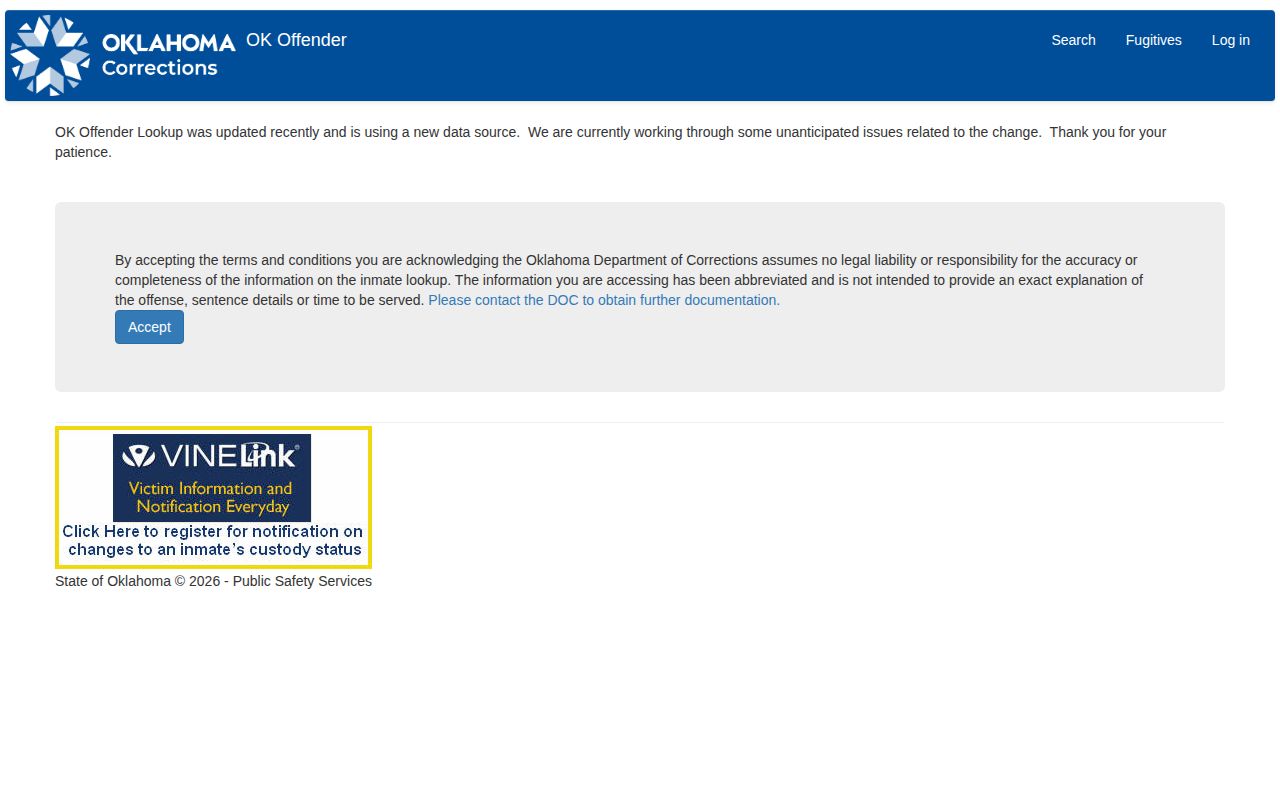
The screen helps locate a sentence record, but its result must be matched to the person and court case.
Greer Future Release Date Limits
ODOC’s Offender Information and FAQ says the future release date of a particular inmate is confidential without a legitimate need such as a judicial or law-enforcement need. The incarcerated person receives days remaining each month and may share that information. Eligible victims with a release concern may contact ODOC Victim Services. These limits mean a caller should not expect ODOC to disclose an exact future date simply because a name and DOC number are public.
A public detail may still contain a discharge date or other sentence data. If a projected or tentative field is actually displayed, label it as a changing estimate and save the date of the lookup. Never back-calculate a date from a sentence length alone. Reception date, jail credit, concurrent or consecutive terms, statutory limits, misconduct, and court changes all matter.
The ODOC offender-information source explains confidentiality and why dates remain tentative.
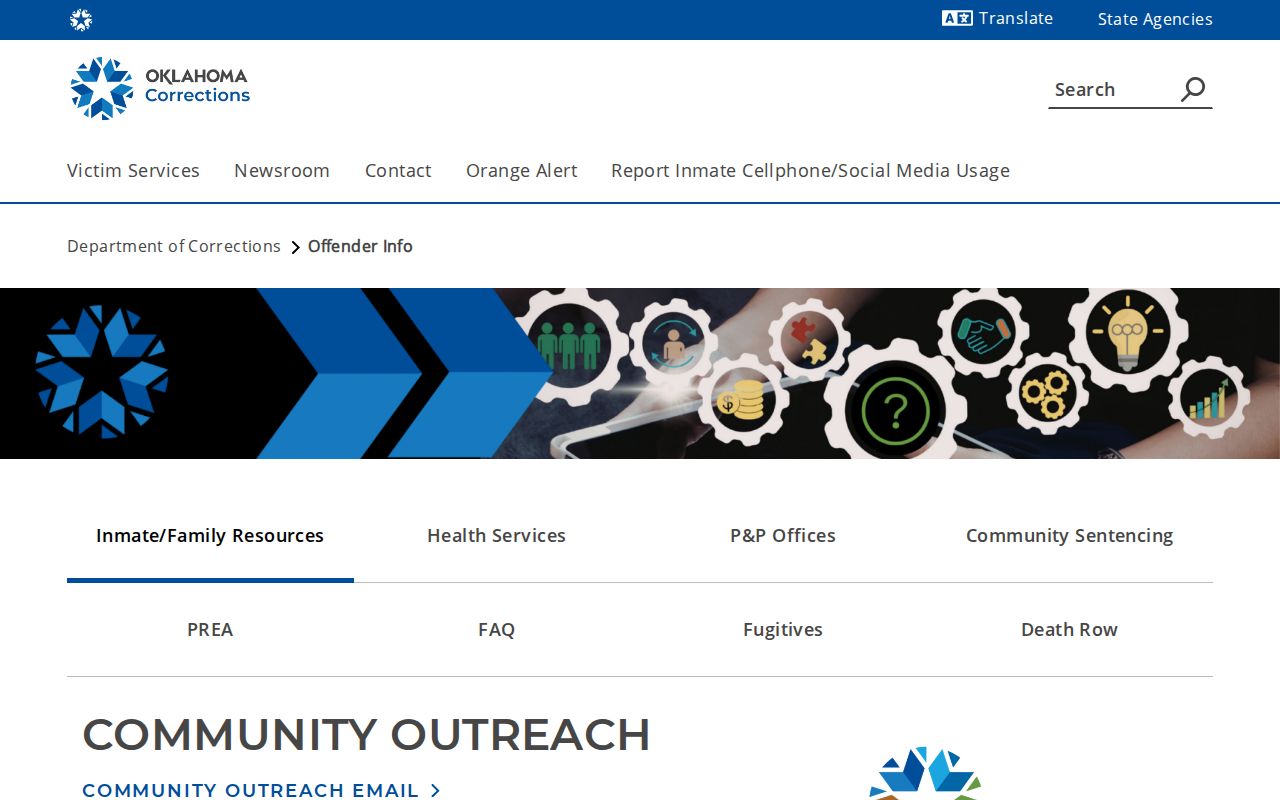
The official warning prevents a public estimate from being presented as a guaranteed release day.
Note: Save the lookup date because sentence data and tentative release information may change after the screen is captured.
Greer Release Dates and Credits
For an ODOC sentence, 57 O.S. §138 authorizes earned credits that can reduce the term. Each credit represents one day of incarceration. Credit earning depends on class and the rules that apply to the sentence. Disciplinary due process may remove credits, and eligible credits may later be restored by a warden or superintendent. ODOC states that restoration is not an entitlement. Achievement credits may also change the estimate.
The operational source is ODOC policy OP-060211. It directs sentence administration and explains the class-based calculation. The policy must be read with the judgment, the law in effect for the offense, and restricted-credit rules. A public reader cannot reproduce the complete official computation from one database row.
- Earned credit
- A sentence credit authorized by law and calculated under ODOC rules.
- Concurrent sentence
- A term that runs at the same time as another term.
- Consecutive sentence
- A term that runs after another term, which can extend the overall date.
- Detainer
- A request or hold from another authority that can affect where a person goes next.
- Discharge
- The recorded completion of the applicable sentence or supervision event.
These ODOC rules apply to state sentences, including a person at Oklahoma State Reformatory. They must not be copied onto a Greer county-jail term. No sourced county rule showed that Sunday or holiday release dates are always advanced to Friday. Direct confirmation is required.
Note: Ask the jail and court for county-sentence credit because ODOC class multipliers do not govern a Greer jail term.
Oklahoma Class Math Changes PRD
Oklahoma’s projected release date is unusually sensitive to class-level math. Current policy gives illustration multipliers of days remaining times .58 for Class 2, .48 for Class 3, .41 for Class 4, .40 for Enhanced Level 3, and .34 for Enhanced Level 4. When class changes, credits are prorated. Those factors show why two snapshots of the same sentence can differ.
The separate projected-release worksheet warns that its examples do not apply to restricted-earned-credit sentences. Therefore, these figures explain the mechanism but are not a do-it-yourself date calculator. A class change may alter the pace at which the estimate moves, while misconduct, restoration, or achievement credit can cause another change.
Title 21 §13.1 adds a different limit. For the offenses listed in the applicable version, at least eighty-five percent of the imposed prison term must be served before parole eligibility, and credits cannot reduce the term below that floor. The list and offense date matter. It is inaccurate to label every violent offense an eighty-five-percent case.
Why Greer Release Dates Change
A PRD changes when one of its inputs or legal limits changes. Some shifts come from conduct and credit class. Others come from a judge, another agency, or the way several sentences run. A favorable parole outcome may also set a later implementation date rather than produce an immediate exit.
| Factor | Possible effect | Record to check |
|---|---|---|
| Class or achievement credit | Changes the credit pace or days applied | ODOC sentence administration record |
| Misconduct or restored credit | Moves the estimate later or earlier | ODOC credit chronology |
| Jail credit | Changes credited time at reception | Judgment, sentence, and ODOC record |
| Concurrent or consecutive terms | Changes how multiple sentences combine | All sentence rows and court judgments |
| Amendment or reversal | Changes the controlling sentence | Court docket and amended order |
| Detainer or warrant | May change destination or toll time | ODOC and receiving-agency record |
| Parole action | May set review, denial, pass, or a future release step | Board result and later ODOC status |
Escape or warrant time can also affect the chronology. When different sentence rows show different dates, do not select the earliest one. The terms may overlap, run consecutively, belong to different courts, or end at different stages. Request the full sentence chronology for reconciliation.
Note: A transfer ends one facility placement but does not end an ODOC sentence or prove community release.
Greer Parole Date Is Separate
Parole eligibility under 57 O.S. §332.7 is date-sensitive. Cases before July 1998 may use older alternatives. For crimes from July 1998 through October 2018, the general framework may use one-third. For ordinary eligible offenses on or after November 2018, the statute generally uses one-quarter, while exclusions and violent-case procedures add limits. Life without parole is excluded. Section 13.1 remains an independent floor for listed offenses.
Eligibility permits consideration only. A Board docket means the case is scheduled. A pass, denial, grant, or recommendation has a different effect, and a recommendation in a violent case may still require gubernatorial action. After a favorable final result, ODOC must implement the custody and supervision change.
The Greer County Parole / Probation page explains the hearing record, result, Altus supervision office, and final discharge path. It should be used alongside, not in place of, the sentence calculation.
Confirm Greer Actual Release
Once the expected date passes, check the correct source again. For ODOC, inspect location, inactive status, and the matching sentence row. A new institution indicates an internal transfer, not release. Inactive status should be paired with the discharge entry and any parole or probation context. If a state record is incomplete, use ODOC Legal Services and Sentence Administration for a public chronology or discharge inquiry.
For Greer County Jail, call or request the closing booking event through the Sheriff Records Division. Ask whether it records bond, time served, dismissal-related release, transfer, or another disposition, plus the receiving agency when relevant. The Greer court docket at ODCR explains legal authority, but it is not the exact gate log. A separate hold can delay exit after an order is entered.
OK VINE may send a custody-change alert, but it is not a permanent release archive and data may lag. Compare any alert with the jail or ODOC record. For a completed state term, the dated discharge row tied to the correct court case is more useful than the old projection.
Record the date and time of each check. If a projection passes without a confirmed release, do not assume the system failed. A detainer, discipline decision, recalculation, court order, or later implementation step may explain the change. Contact the current custodian and ask which existing record shows the revised computation or destination. For county custody, no published Greer rule supports moving a Sunday or holiday date to Friday, so case-specific jail and court confirmation remains essential.